
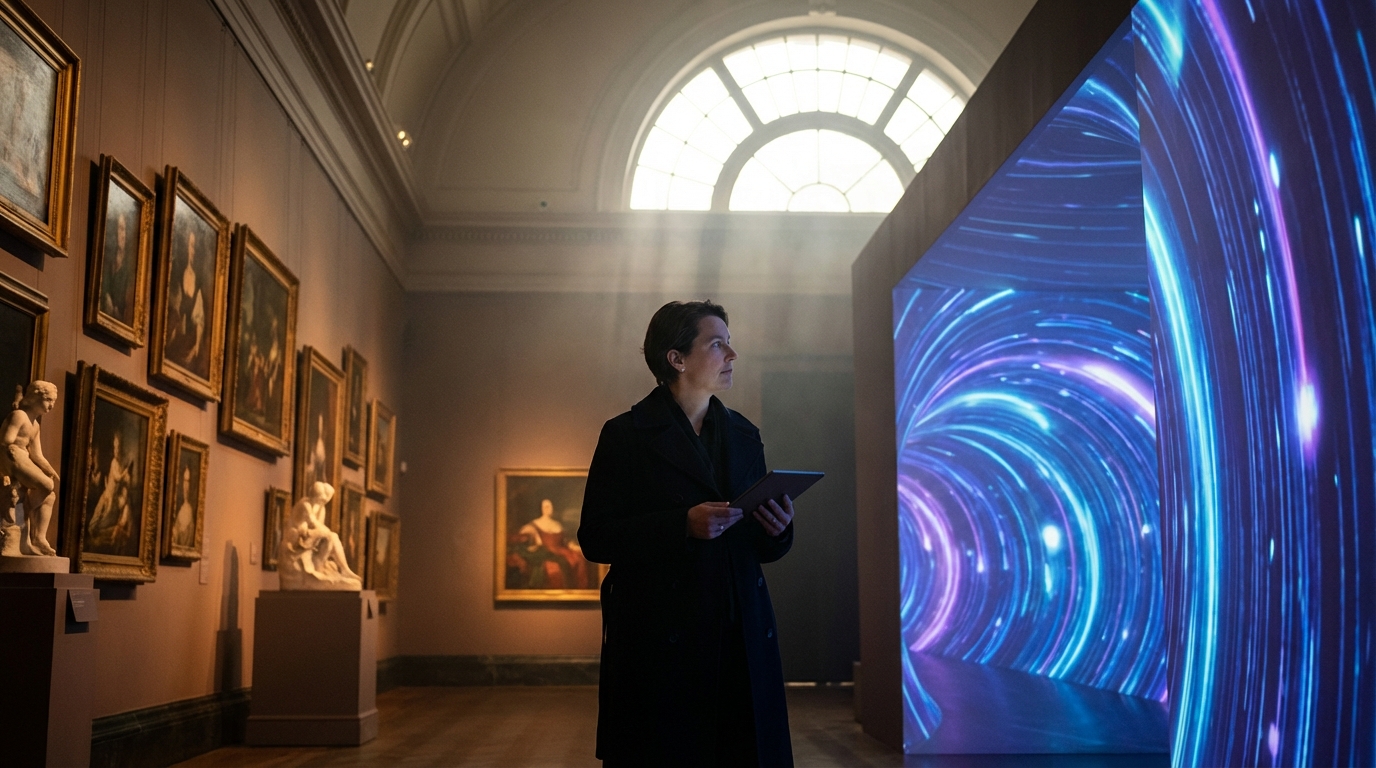
Every museum director faces a version of the same impossible choice. On one side stands tradition: the carefully refined displays, the expanding collections, the scholarly authority that took generations to build. On the other stands the relentless pressure of modernity: the VR stations, the AR apps, the touchscreens that promise innovation but deliver isolation. Neither path is satisfying. Neither path is enough.
🎬 Watch Cagliostro in Action:
But what if the choice itself was wrong?
The Impossible Choice That Isn’t
Traditional curation has an undeniable power. It maintains institutional authority, respects collection integrity, and honors the serious intellectual work that scholarship demands. But it has a critical flaw in the modern landscape: static displays lack urgency for modern audiences. Passive observation, however beautifully arranged, is simply no longer sufficient to hold attention in an era of infinite competing stimuli. Visitor numbers decline, and they keep declining.
Digital integration seems like the answer. VR headsets and AR overlays signal innovation and can produce a temporary boost in ticket sales. But the honeymoon is brief. The technology becomes obsolete quickly, demanding expensive ongoing maintenance. Worse, screens have a tendency to overshadow the very collection they were meant to illuminate — visitors end up looking at the interface rather than the artifact.
These are not marginal problems. They are fundamental design flaws in both approaches.
The Third Path: Immersive Narrative Design
There exists a third way — one that refuses the false binary between silence and screens. It is a hybrid approach that merges the educational depth of great curation with the electric engagement of active participation, transforming your venue into something it has never been before: a living mystery.
The methodology is precise. Escape game mechanics — proven over decades to compel sustained attention, genuine collaboration, and deep observation — are applied not as a layer on top of the collection, but woven directly through it. The artifacts become the puzzles. The history becomes the story. The visitors become the protagonists.
- Deep Engagement — Visitors spend 150% more time analyzing artifacts to solve puzzles and uncover stories hidden within the collection itself.
- Social Connection — Teams work together, fostering genuine conversation and shared discovery rather than the isolated screen-staring that digital overlays tend to produce.
- Bespoke Magic — Stories are custom-built to highlight the unique mysteries of your specific collection — not generic content applied to any museum anywhere.
- Revitalized Revenue — Premium experiences attract new demographics and new funding streams without requiring any alteration to your permanent collections.
How the Experience Unfolds
The immersive narrative experience transforms the museum visit into a three-act journey that visitors actively construct:
Step One: Observe Closely
Visitors must analyze artifacts carefully to discover hidden clues and solve intricate puzzles woven into your exhibits. The act of looking — truly looking — becomes purposeful and rewarding. A painting that might receive a ten-second glance in a traditional setting now commands ten minutes of focused, engaged attention.
Step Two: Collaborate and Connect
Teams work together to unlock the narrative, creating meaningful social experiences that replace isolated screen time. The museum becomes a place of conversation, debate, and shared discovery. Families reconnect. Groups of strangers become temporary allies.
Step Three: Unlock the Story
As mysteries unfold, visitors gain a deeper understanding of your collection’s history and significance — education achieved not through passive reception but through active engagement. The knowledge earned through discovery is knowledge that stays.
Who This Is For — And Who It Isn’t
Intellectual honesty demands acknowledging that this approach is not for everyone. If your primary goal is purely academic preservation and you are content with your current audience size, the traditional path remains valid and honorable. If you are seeking a quick, flashy technology upgrade regardless of long-term maintenance costs or the risk of visitor isolation, digital overlays may serve a temporary purpose.
But if you need to revitalize your institution with an experience that is both respectful of history and radically engaging — if you need to build bridges to younger audiences without alienating the ones you already serve — immersive narrative storytelling offers something the other paths cannot: a powerful middle ground that allows you to maintain the integrity of your collection while sparking the imagination of a new generation.
The Evidence Is In
Across more than 40 museums worldwide, the numbers tell a consistent story. Institutions that have chosen the third path report 150% longer visits, 89% visitor satisfaction rates, and 300% revenue growth from premium experience programming. These are not marginal improvements. They are transformations.
The traditional approaches are not wrong — they are simply incomplete. The digital overlays are not worthless — they are simply insufficient. The third path does not reject what came before. It takes the best of both worlds and fuses them into something entirely new: an experience so alive, so personal, and so unforgettable that visitors cannot help but return — and cannot help but bring others.
The impossible choice was never really a choice at all. It was an invitation to imagine something better.